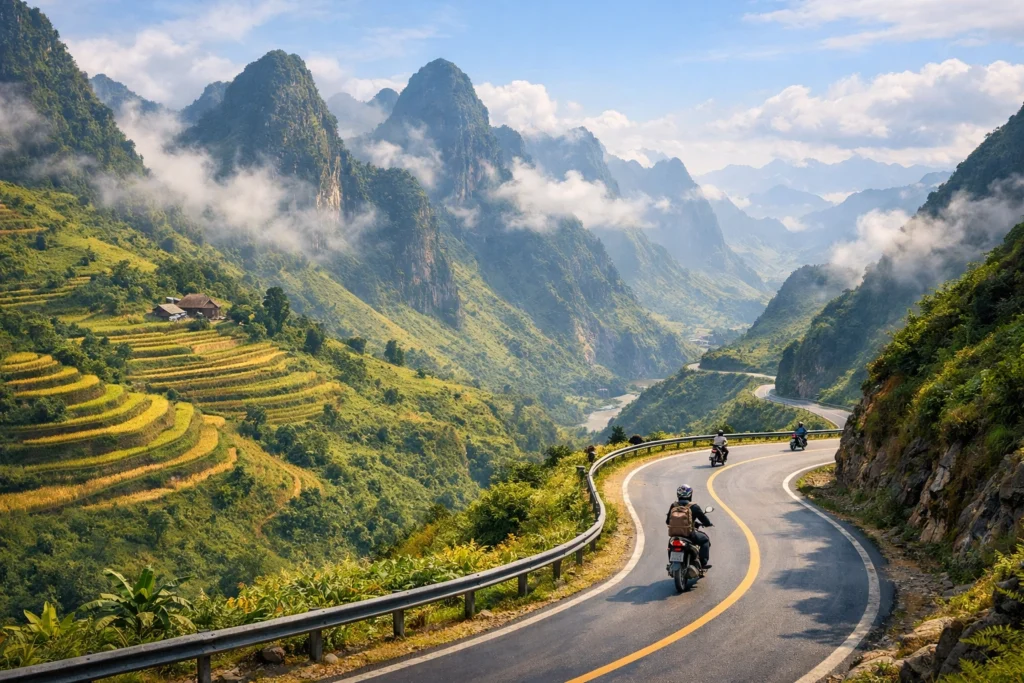
Planning a ha giang loop tour is one of those travel ideas that stays in your head until you finally do it. High limestone peaks, rice terraces, tiny villages, children waving from the roadside, and the feeling of real freedom on the motorbike make this region of northern Vietnam very special. For many German travelers, this is the most authentic part of the country, far away from the usual tourist paths.
Why the ha giang loop tour is different from other Vietnam trips
Vietnam has many famous routes, but the ha giang loop tour feels more raw and honest. The landscape is wilder, tourism is less developed, and the culture of ethnic minority groups is still very strong. You hear different languages, see traditional clothes, and share rice wine with families in simple homestays.
For us as travelers from Germany, this tour is also a small step out of our comfort zone. The roads can be narrow, weather changes fast, and traffic rules are not the same as at home. At the same time, this is exactly what makes the ha giang loop tour so memorable. With the right planning and safety mindset, it is a rewarding and manageable adventure.
Overview of the ha giang loop tour: distance, days, and travel style
The classic ha giang loop tour starts and ends in Ha Giang City, close to the Chinese border. From here you ride through Dong Van Karst Plateau Geopark and some of the most dramatic mountain views in Southeast Asia.
Key facts for orientation:
- Total distance of the classic loop: about 350 to 400 kilometers
- Recommended duration: 3 to 5 days on the motorbike
- Main transport: semi-automatic or manual motorbike, or car with driver
- Difficulty: moderate to challenging, depending on driving experience and weather
You can ride the ha giang loop tour on your own bike, book a guided group tour, or hire an easy rider who drives the motorbike for you while you sit on the back. For many people who are not confident on steep mountain roads, the easy rider option is the best mix of safety and freedom.
Detailed route for a 3 to 5 day ha giang loop tour
We divide the ha giang loop tour into stages that follow the typical direction: counterclockwise from Ha Giang to Dong Van, then to Meo Vac, and back via Mau Due and Du Gia.
Day 1: Ha Giang City to Quan Ba and Yen Minh
Distance: 70 to 90 km
Leaving Ha Giang, the road climbs fast into the mountains. The first highlight is Quan Ba Heaven Gate with a wide view over the Tam Son valley and the so-called Fairy Bosom Hills. You start to understand why so many travelers say the ha giang loop tour has the best landscapes in Vietnam.
The road here is curvy but not yet extreme. For a first day it helps to keep the distance short, stop often for photos, and get used to the bike. Many homestays in Nam Dam (a Dao minority village) or in Yen Minh town offer dinner with the family, homemade corn wine, and simple but clean rooms.
Day 2: Yen Minh to Dong Van and the Ma Pi Leng Pass
Distance: 80 to 100 km (depending on side trips)
Between Yen Minh and Dong Van, the land becomes rocky and more dry. Traditional stone houses, terraced fields, and women carrying huge baskets on their backs show daily life in this harsh environment. A popular stop is the Hmong King Palace near Sa Phin, once the home of a powerful local leader.
Dong Van old quarter has small clay houses, evening street food, and in the right season, markets where ethnic groups sell animals, textiles, and herbal medicines. Many travelers use Dong Van as a base to explore nearby viewpoints.
The Ma Pi Leng Pass between Dong Van and Meo Vac is often called the most beautiful pass of Vietnam. Deep gorges, the Nho Que River far below, and vertical rock walls make this part of the ha giang loop tour unforgettable. There are several viewpoints where you can safely park the bike and simply stand in silence for a few minutes. Some tours include a boat trip on the Nho Que River, which gives a very different angle of the same landscape.
Day 3: Meo Vac to Du Gia or back to Ha Giang
Distance: 100 to 140 km
From Meo Vac you have two main choices. If you are on a tight schedule, you can follow the direct road via Mau Due back to Ha Giang in one long driving day. This is possible but can feel rushed, especially in bad weather.
The more relaxed option is to ride from Meo Vac to Du Gia Village, a peaceful valley with green rice fields and a slower rhythm. Many homestays here are family-run. You eat on the ground with the hosts, sleep on wooden floors with mosquito nets, and wake up to roosters instead of alarms. There are small waterfalls nearby where you can swim if the current is not too strong.
Day 4 to 5: Du Gia back to Ha Giang with extra stops
Distance: 70 to 100 km per day
If you have 4 or 5 days for your ha giang loop tour, you can spread out the last stretch, add small side roads, or simply arrive early and relax. On the way back to Ha Giang City, the landscape becomes softer again, with more villages and less extreme cliffs. It is a good moment to stop at viewpoints one last time and look back on the road you just completed.
Cost breakdown of a ha giang loop tour
Prices change between seasons and years, but the ha giang loop tour is still good value for money compared to experiences of similar quality in Europe. We give approximate ranges in euro to help planning from a German perspective.
Transport and motorbike rental
Most travelers take a night bus from Hanoi to Ha Giang City. A sleeper bus ticket costs usually between 12 and 20 euro, one way, depending on comfort and agency. The ride takes around 6 to 7 hours.
In Ha Giang you can rent a motorbike or join a guided ha giang loop tour. Typical prices:
- Motorbike rental: 7 to 15 euro per day, depending on bike type and insurance
- Easy rider (driver + bike): 20 to 35 euro per day per person, including the driver but not always fuel
- Full guided group tour (3 days / 2 nights): around 130 to 200 euro, including bike, fuel, guide, some meals, and homestays
For travelers without strong motorbike skills, booking a ha giang loop tour with easy rider is usually the safest and most relaxing way.
Accommodation and meals
Homestays are popular along the loop. They are usually basic but friendly, with shared bathrooms and hot water in most places.
Average prices:
- Homestay dorm: 5 to 8 euro per night, including simple breakfast
- Private room in homestay or guesthouse: 10 to 20 euro per night
- Meals (local food): 2 to 5 euro per meal
Many homestays offer a family dinner for a fixed price, with several dishes shared at the table and often some rice wine. This is a good chance to talk with hosts and other travelers about their ha giang loop tour experiences.
Fuel, entrance fees, and small extras
Fuel is not a big cost factor. For a full ha giang loop tour of 3 to 4 days, you usually spend around 10 to 20 euro on petrol, depending on engine size and distance. Entrance fees to viewpoints or palaces are low, often under 2 euro.
Other possible costs:
- Boat trip on Nho Que River: 7 to 12 euro
- Travel insurance with motorbike coverage: depends on your German provider, but should be arranged before the trip
- Tips for guides and drivers: not mandatory, but appreciated if service is good
Best time and weather for a ha giang loop tour
Weather has a big influence on how you experience the ha giang loop tour. Fog, rain, and landslides can make driving difficult, while clear skies reveal the full beauty of the mountains.
Month by month overview
March to May: Spring is one of the nicest times. Temperatures are mild, fields turn green, and visibility is usually good. There might be short rain showers, but heavy storms are less common than in summer.
June to August: Hot and humid with stronger sun. This is also the main rainy season. While the landscape is very lush and green, you must be prepared for sudden downpours, slippery roads, and possible landslides. A ha giang loop tour in this period requires flexible planning and respect for local warnings.
September to November: Many experienced travelers consider this the best time. Clear blue skies, pleasant temperatures during the day, and rice harvest scenes in some valleys. Nights in the higher areas can already be cool, so a light jacket is useful.
December to February: Winter in Ha Giang can be cold and gray, especially around Dong Van and Ma Pi Leng Pass. Temperatures sometimes drop close to zero at night, and fog can limit visibility. If you choose this time for a ha giang loop tour, pack warm clothes and be ready for slower driving.
How weather affects safety and comfort
On dry days the road conditions are much easier. You can take your time in curves, stop for photos, and enjoy the views. In heavy rain, water can run across the road, hiding potholes or mud. In fog, you might see only a few meters, which is dangerous above steep cliffs.
It helps to check weather apps as well as ask locals each morning. If truck drivers or guides say the Ma Pi Leng Pass is not safe for the day, respect their experience. A ha giang loop tour can always be shortened or paused; your health cannot be replaced.
Safety tips for the ha giang loop tour
From a German perspective, the driving culture and road quality in Ha Giang are very different from our home roads. Good preparation reduces risk and lets you enjoy the adventure with more peace of mind.
Motorbike skills and legal points
If you plan to drive yourself, you should feel comfortable with:
- Handling a semi-automatic or manual bike
- Using brakes correctly in steep downhill sections
- Taking tight curves at low speed
In theory, Vietnam requires an international driving permit plus a valid motorbike license from your home country for full legal coverage. Many rental shops still rent to people without, but your travel insurance might refuse payment in case of an accident. For a worry-free ha giang loop tour, we strongly suggest checking both your license situation and your insurance policy before you leave Germany.
Protective gear and equipment
Rental shops often offer helmets that are more for city use than for mountain roads. If possible, choose a full-face helmet with visor. At minimum, wear:
- Closed shoes or boots
- Long trousers
- Long sleeves or a light jacket
- Rain jacket and rain trousers during wet season
Gloves protect your hands from both cold wind and falls. A small first aid kit with disinfectant, bandages, and painkillers is also practical. Even if you join a guided ha giang loop tour, carrying basic items for your own comfort is wise.
Driving behavior and common hazards
Some typical risks on the loop:
- Loose gravel in curves
- Dogs, chickens, or children stepping onto the road
- Larger vehicles cutting corners on mountain passes
- Sudden fog or strong side wind
Defensive driving is key. Keep your speed low enough to always stop within the distance you can see. Use your horn before blind corners, as local drivers also do. Avoid driving in the dark; plan to arrive at your homestay well before sunset.
Alcohol is another sensitive point. On some ha giang loop tour nights, hosts pour rice wine very generously. It is perfectly acceptable to say no or to drink very little, especially if you will drive the next morning. Your safety is more important than being polite.
Choosing between self-drive and guided ha giang loop tour
Both options have clear benefits. Your choice depends on your experience, budget, and personality.
Self-drive: freedom with responsibility
Driving yourself gives you full control over stops, photos, and rhythm. You can stay longer in a village you like, or leave earlier if a place feels crowded. For many, the feeling of riding the curves of the Ma Pi Leng Pass with their own hands is the highlight.
However, you must handle navigation, communication with locals, and all safety decisions alone. Without Vietnamese language skills, dealing with mechanical problems or accidents can become stressful.
Guided tour or easy rider: comfort and local insight
Joining a guided ha giang loop tour removes many worries. The guide knows the route, the current road situation, and trusted homestays. You hear stories about local customs and history that you might not discover on your own. If you sit behind an easy rider, you can relax, take photos, and fully watch the landscape without thinking about the next curve.
Costs are higher than self-drive, but for many German travelers, the extra safety and insight is worth the price, especially on shorter trips of 3 or 4 days.
Cultural respect and responsible behavior on the loop
The ha giang loop tour passes through areas where ethnic minority communities live from farming, small trade, and sometimes tourism. Showing respect makes the experience better for both sides.
Some simple guidelines:
- Ask before taking close-up photos of people, especially children
- Dress modestly in villages and homestays, even if it is hot
- Do not walk into houses or fields without invitation
- Buy snacks or handmade items locally instead of only in Hanoi
- Take your trash with you; mountain roads easily collect plastic
When you stay in a homestay, eating what the family cooks and joining simple activities supports their income. For them, the ha giang loop tour is not just a picture on Instagram, but a real chance to earn money and still live in their home region.
Practical packing list for German travelers
Besides normal Vietnam travel items, a ha giang loop tour calls for some specific things:
- International driving permit and German driving license (if self-driving)
- Printed or offline map of the loop
- Windproof and waterproof jacket
- Thin fleece or sweater for cold nights
- Quick-dry clothes and spare socks
- Power bank and offline translation app
- Cash in Vietnamese dong; ATMs are limited in some areas
Most homestays offer blankets, but if you are sensitive to cold, a thin sleeping bag liner can increase comfort. Earplugs help when roosters start early or other travelers snore in the dorm.
Final thoughts: is the ha giang loop tour for you
A ha giang loop tour is not a luxury holiday. Roads can be rough, bathrooms simple, and your hair will smell like dust and rain at the same time. But if you appreciate real landscapes, human contact, and a bit of challenge, this route will probably become one of your strongest memories from Vietnam.
With clear planning of route, costs, weather window, and safety measures, even someone who is not a hardcore adventurer can enjoy the ha giang loop tour. Whether you ride your own bike or sit behind an easy rider, the feeling of standing on the Ma Pi Leng Pass, looking down at the river and up to the sky, is difficult to describe and hard to forget.