When we speak a new language, saying thank you is often one of the first things we learn. If you search for thank you in German, you will usually see only two basic words: danke and dankeschön. In real life in Germany, Austria, and Switzerland, we use many more phrases, tones, and small nuances. Learning them helps you sound polite, natural, and more like a local.
Why learning “thank you in German” matters for real life
Politeness is taken very seriously in German-speaking countries. We use different forms of thank you in German depending on:
- How well we know the other person
- The situation informal or formal
- How strong our gratitude is
- Regional habits, for example in Bavaria or Switzerland
When you choose the right way to say thank you in German, you show respect for the culture. People react more kindly, they are more patient with your accent, and they often switch to slower, clearer German for you.
How to read the German pronunciation in this guide
To keep things simple, we give you an easy phonetic help in brackets, not the full IPA symbols. It is not perfect, but it helps you say thank you in German in a way that Germans will understand.
For example:
- danke [DAHN-keh]
- bitte [BIH-teh]
We write the stressed part of the word in CAPITAL letters. The sounds are approximations, but they work well for most learners.
1. The most common way to say thank you in German
1.1 Danke – the everyday standard
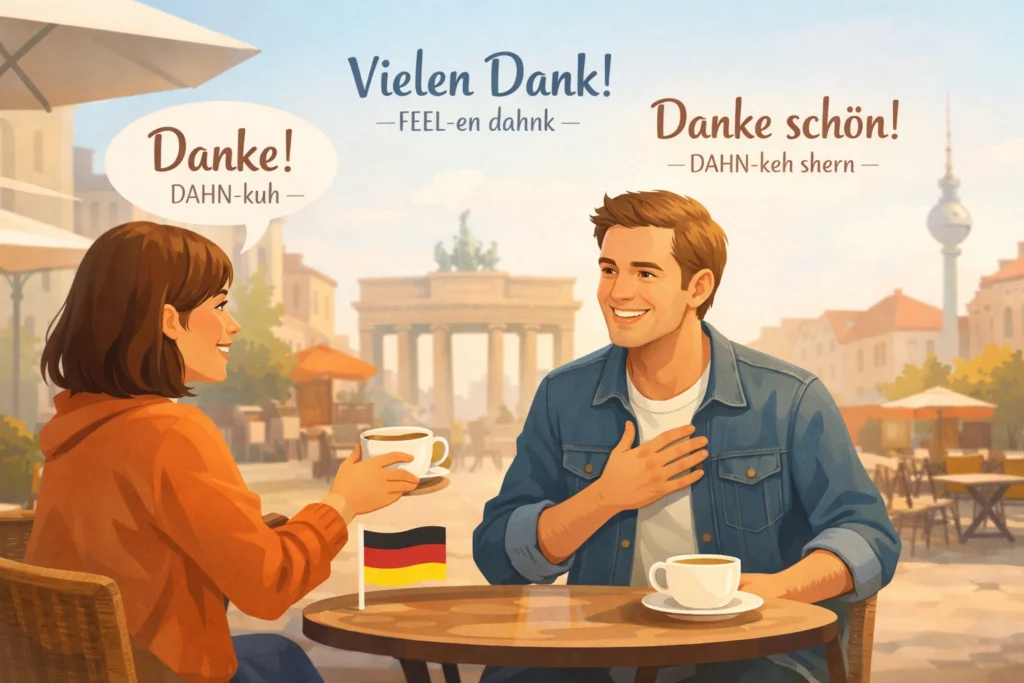
danke [DAHN-keh]
This is the basic and most frequent way to say thank you in German. You can use it in almost any situation: in a shop, with friends, with colleagues, even with strangers on the street.
Example: Someone holds the door for you. You smile and say: Danke.
1.2 Dankeschön – a bit warmer and nicer
dankeschön [DAHN-keh-shoen]
Dankeschön feels a little friendlier and slightly more emotional than just danke. It is a common and polite way to say thank you in German when someone really makes an effort for you.
Example: A colleague helps you with a difficult email in German. You say: Dankeschön, das war sehr hilfreich.
1.3 Danke schön – with a tiny pause
danke schön [DAHN-keh shoen]
Written as two words, danke schön is basically the same as dankeschön. Some speakers feel that the two-word version sounds a little more formal, but in daily life we use both forms freely.
2. More polite ways to say thank you in German
2.1 Vielen Dank – many thanks
vielen Dank [FEE-len dahnk]
This is a very common and polite form of thank you in German. You hear it a lot in emails, in shops, in offices, and from customer service staff.
Example: At the end of a phone call with your bank, the employee says: Vielen Dank für Ihren Anruf. (Many thanks for your call.)
2.2 Herzlichen Dank – heartfelt thanks
herzlichen Dank [HERTS-lih-chen dahnk]
We use herzlichen Dank when we want to show warm and sincere gratitude, but still in a polite and sometimes formal way. It fits well in speeches, emails, and thank you cards.
Example: After a job interview, you can write: Herzlichen Dank für das freundliche Gespräch.
2.3 Besten Dank – best thanks
besten Dank [BEST-en dahnk]
Besten Dank is very common in business German and in written communication. It is polite and slightly formal, and you often see it at the end of emails.
Example: Besten Dank für Ihre schnelle Antwort. (Thank you very much for your quick reply.)
3. Stronger ways to express deep gratitude
3.1 Vielen lieben Dank – many dear thanks
vielen lieben Dank [FEE-len LEE-ben dahnk]
This phrase is very warm and personal. We use it with friends, family, close colleagues, and people we like and trust. It shows real emotion.
Example: A friend helps you move to a new flat. You say: Vielen lieben Dank für deine Hilfe heute.
3.2 Tausend Dank – a thousand thanks
tausend Dank [TOW-send dahnk]
Tausend Dank is informal and a bit playful. It shows that you are really thankful. It sounds good in spoken German and in messages to friends or friendly colleagues.
Example: Your colleague switches shifts with you. You write: Tausend Dank, dass du einspringst.
3.3 Ich danke dir / Ich danke Ihnen – I thank you
ich danke dir [ikh DAHN-keh deer] informal
ich danke Ihnen [ikh DAHN-keh EE-nen] formal
This phrase is a bit more serious and emotional than a simple danke. You can use it when you really want to highlight the act of thanking.
Example: Ich danke Ihnen für Ihr Vertrauen. (Formal: I thank you for your trust.)
3.4 Ich bin dir sehr dankbar – I am very grateful to you
ich bin dir sehr dankbar [ikh bin deer zair DAHNK-bar] informal
ich bin Ihnen sehr dankbar [ikh bin EE-nen zair DAHNK-bar] formal
With this phrase, you say clearly that the other person did something important for you. It is one of the strongest ways to say thank you in German, especially in serious situations.
Example: After someone supports you during a difficult time, you may say: Ich bin dir sehr dankbar, dass du für mich da warst.
4. Casual and regional ways to say thank you in German
4.1 Danke dir – thanks to you (informal)
danke dir [DAHN-keh deer]
This form is widely used among friends and people you talk to with du. It is informal but still polite and friendly.
Example: A friend sends you notes from class. You reply: Danke dir fürs Mitschreiben.
4.2 Danke euch – thanks to you all
danke euch [DAHN-keh oich]
Use this when you thank a group of people you address as ihr (informal plural you). It creates a feeling of togetherness.
Example: To a group of friends who helped you organise a party: Danke euch, ohne euch hätte das nicht geklappt.
4.3 Danke schön, danke sehr – thankful, sometimes playful
danke schön [DAHN-keh shoen]
danke sehr [DAHN-keh zair]
Both versions are polite and a little old-fashioned in a charming way. You sometimes hear them in customer service or from older people. They can sound very friendly if you say them with a warm tone.
4.4 Merci – especially in the south and in Switzerland
merci [MER-see]
Due to French influence, people in the south of Germany, in Austria, and especially in Switzerland often say merci in daily life. It is casual, warm, and very common there.
Example: In a bakery in Zurich, you pay and say: Merci, schönen Tag noch.
5. Thank you in German for specific situations
5.1 When receiving a gift
Germans usually say more than just danke when they get a present. They comment on the gift and show real appreciation.
Useful phrases:
- Danke, das ist aber lieb. [DAHN-keh, dass ist AH-ber leeb] – Thank you, that is so kind.
- Vielen Dank, das freut mich sehr. [FEE-len dahnk, dass froit mikh zair] – Many thanks, that makes me very happy.
- Das ist ein tolles Geschenk, danke. [dass ist ine TOL-les ge-SHENK, DAHN-keh] – That is a great gift, thank you.
5.2 When someone helps you
Help and support are important moments for expressing thank you in German. A little bit of detail about what you are thankful for makes your words more authentic.
Examples:
- Vielen Dank für deine Hilfe. – Many thanks for your help. (informal)
- Herzlichen Dank für Ihre Unterstützung. – Heartfelt thanks for your support. (formal)
- Ohne dich hätte ich das nicht geschafft, tausend Dank. – Without you I would not have managed this, a thousand thanks.
5.3 In shops, cafés, and restaurants
Service staff in German-speaking countries often work under time pressure, but politeness still matters. Short, clear forms of thank you in German are perfect here.
Typical small dialogues:
Cashier: 5 Euro 80, bitte.
You: Hier, bitte. Danke.
Waiter: Schmeckt es Ihnen?
You: Ja, sehr gut, danke.
You can add a goodbye phrase at the end:
- Danke, schönen Tag noch. – Thank you, have a nice day.
- Vielen Dank, auf Wiedersehen. – Many thanks, goodbye.
6. Formal thank you in German for work and emails
6.1 Safe email formulas
In professional life, tone is very important. Here are reliable expressions that sound polite and respectful in almost every business context:
- Vielen Dank für Ihre Nachricht. – Many thanks for your message.
- Besten Dank im Voraus. – Many thanks in advance.
- Herzlichen Dank für Ihre Unterstützung. – Sincere thanks for your support.
- Vielen Dank für die gute Zusammenarbeit. – Many thanks for the good cooperation.
6.2 Closing lines with thank you
You can combine thank you in German with friendly closing formulas. For example:
- Vielen Dank und freundliche Grüße
- Besten Dank und bis bald
- Herzlichen Dank und einen schönen Tag
These lines show both gratitude and goodwill, which is very welcome in German work culture.
7. Saying “no, thank you” in German
Sometimes we want to refuse something politely. Then we combine nein or kein with thank you in German.
Useful phrases:
- Nein, danke. – No, thank you.
- Danke, aber nein. – Thank you, but no.
- Nein, danke, das ist sehr freundlich. – No, thank you, that is very kind.
- Danke, ich habe schon. – Thank you, I already have (some).
The extra words after your thank you make your refusal sound softer and more polite.
8. How to react when someone says thank you in German
To sound natural, we also have to know how to answer when another person thanks us. In German, we normally answer with variations of bitte.
8.1 Basic responses
- Bitte. [BIH-teh] – Short and standard. Means “you are welcome”.
- Bitte schön. [BIH-teh shoen] – Slightly more friendly.
- Bitte sehr. [BIH-teh zair] – Also polite and kind.
8.2 More personal responses
- Gern. [GERRN] – Gladly.
- Gerne. [GERR-neh] – Same meaning, slightly softer.
- Gern geschehen. [GERRN ge-SHEH-en] – Gladly done.
- Kein Problem. [kine proh-BLEM] – No problem.
- Immer gerne. [IM-mer GERR-neh] – Always happy to.
Combining them sounds very natural, for example: Gern geschehen, bitte. or Kein Problem, gerne.
9. Cultural tips for using thank you in German
9.1 Formal vs informal: du and Sie
German has two forms of “you”:
- du for friends, family, children, and sometimes young colleagues
- Sie for formal situations, older people you do not know well, and business contacts
This difference also affects thank you in German. For example:
Informal: Vielen Dank für deine Hilfe.
Formal: Vielen Dank für Ihre Hilfe.
Switching too early from Sie to du can feel disrespectful. If you are not sure, always start with Sie.
9.2 When Germans expect a “thank you”
In German culture, there are certain moments where thank you in German is almost automatic:
- When you receive something (change, food, documents)
- When someone opens a door or makes space for you
- When someone gives you information or directions
- At the end of a service interaction, for example in a shop
Even a simple danke with a small smile can make everyday interactions much smoother.
9.3 Avoiding over-the-top language
Germans usually do not exaggerate with very big emotional words for small things. For example, Ich bin dir auf ewig dankbar (I am grateful to you forever) is very dramatic and used only in special moments. For normal help, a calm and honest thank you in German feels more authentic.
10. Quick overview: 25 real-life phrases for thank you in German
Here is a compact list of useful expressions you can start using right away:
- Danke.
- Dankeschön.
- Danke schön.
- Vielen Dank.
- Herzlichen Dank.
- Besten Dank.
- Vielen lieben Dank.
- Tausend Dank.
- Ich danke dir.
- Ich danke Ihnen.
- Ich bin dir sehr dankbar.
- Ich bin Ihnen sehr dankbar.
- Danke dir.
- Danke euch.
- Merci. (regional)
- Danke, das ist aber lieb.
- Vielen Dank für deine Hilfe.
- Herzlichen Dank für Ihre Unterstützung.
- Nein, danke.
- Nein, danke, das ist sehr freundlich.
- Bitte. / Bitte schön. / Bitte sehr.
- Gern. / Gerne.
- Gern geschehen.
- Kein Problem, gerne.
11. How to practice thank you in German every day
Using thank you in German in real situations is the best way to fix these phrases in your memory. You can:
- Use a different form of danke every day in shops or cafés
- Write emails to friends or colleagues including vielen Dank or besten Dank
- Listen carefully to how native speakers answer your thank you with different forms of bitte
- Practice small dialogues at home out loud, including both thank you and the reply
The more you play with these phrases, the more natural your thank you in German will sound. You do not need perfect grammar; a sincere tone and a friendly smile carry a lot of meaning.
When you choose from these 25 real-life phrases for thank you in German, you show more than language skills. You show respect, warmth, and a real wish to connect with people in their own language. This small word can open many doors in German-speaking countries.